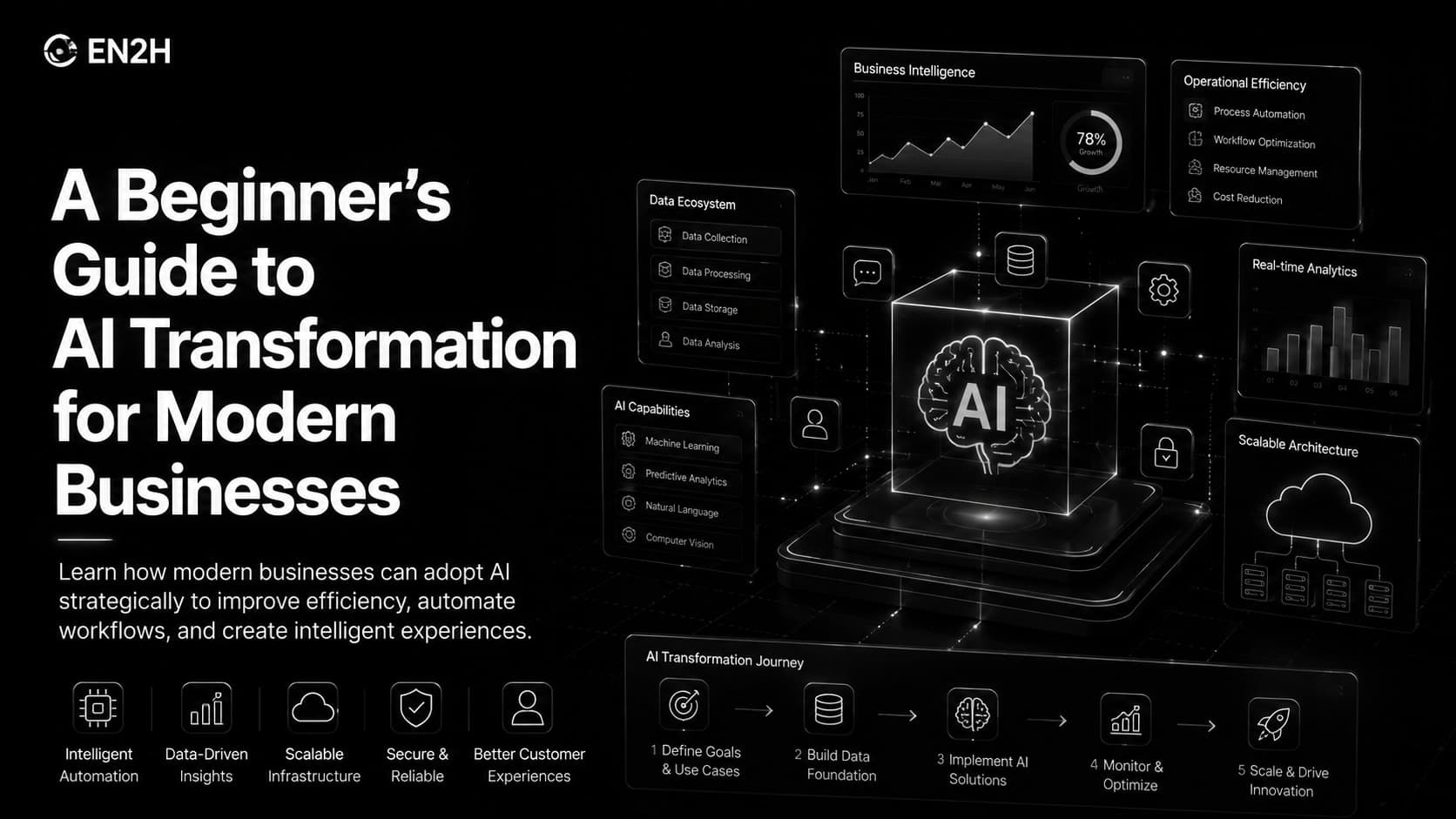
A Beginner’s Guide to AI Transformation for Modern Businesses
Artificial Intelligence is rapidly changing how modern businesses operate, compete, and grow.
What was once considered an experimental technology is now becoming a core part of business operations across industries such as healthcare, finance, education, media, retail, logistics, and enterprise software.
From automation and analytics to customer engagement and intelligent decision-making, AI is helping organizations improve efficiency, reduce operational costs, and create better digital experiences.
However, many businesses still struggle to understand what AI Transformation actually means and how to begin implementing it effectively.
At EN2H, we help organizations adopt AI strategically by building scalable AI-first digital systems, intelligent workflows, and modern operational ecosystems designed for long-term growth.
AI Transformation is not simply about adding AI tools to a business.
It is about redesigning how organizations operate using intelligent systems and data-driven processes.
What Is AI Transformation?
AI Transformation refers to the process of integrating Artificial Intelligence into business operations, products, services, workflows, and decision-making systems.
The goal is to improve:
Efficiency
Automation
Scalability
Customer experience
Data analysis
Operational intelligence
Business performance
AI Transformation affects both technology and business strategy.
It involves:
Modernizing systems
Automating repetitive tasks
Building intelligent workflows
Using data more effectively
Improving operational visibility
Creating AI-powered customer experiences
Organizations that successfully adopt AI can operate faster, smarter, and more efficiently.
Why AI Transformation Matters
Modern businesses operate in increasingly competitive digital environments.
Companies are now expected to:
Deliver faster services
Personalize user experiences
Process large amounts of data
Operate efficiently at scale
Make real-time decisions
Adapt quickly to market changes
Traditional manual workflows often cannot keep up with these demands.
AI helps businesses solve these challenges by enabling intelligent automation and data-driven operations.
Businesses that delay AI adoption may struggle to compete with organizations that use AI to improve efficiency and customer engagement.
Common Misconceptions About AI
Many organizations avoid AI adoption because they believe:
AI is only for large enterprises
AI requires massive budgets
AI replaces human workers completely
AI systems are too complex
AI transformation requires rebuilding everything
In reality, AI adoption can begin gradually and strategically.
Most successful AI transformations start with small operational improvements and scalable automation systems.
AI should enhance human productivity — not replace human value entirely.
Areas Where Businesses Can Use AI
AI can create value across many operational areas.
Customer Support
AI-powered systems can help businesses:
Automate support responses
Improve response times
Handle repetitive inquiries
Provide 24/7 assistance
Analyze customer sentiment
Business Intelligence & Analytics
AI helps organizations:
Analyze operational data
Predict trends
Detect anomalies
Generate intelligent insights
Improve forecasting
Workflow Automation
Businesses can automate:
Internal processes
Reporting systems
Notifications
Approval workflows
Data processing tasks
Personalized User Experiences
AI enables:
Recommendation systems
Personalized content
Smart search
Audience segmentation
Adaptive digital experiences
Marketing & Sales
AI can improve:
Campaign optimization
Lead scoring
Customer targeting
Behavioral analysis
Sales forecasting
The First Step in AI Transformation
One of the biggest mistakes businesses make is trying to implement AI everywhere at once.
Successful AI Transformation starts by identifying:
Repetitive workflows
Operational bottlenecks
Data inefficiencies
Customer experience challenges
Areas where automation creates measurable value
Organizations should begin with clear business problems instead of adopting AI simply because it is trending.
At EN2H, we focus heavily on strategic AI adoption rather than unnecessary complexity.
Building a Strong Data Foundation
AI systems depend heavily on data quality.
Without structured and reliable data, AI systems produce weak or inaccurate results.
Businesses need:
Centralized data systems
Clean datasets
Reliable infrastructure
Data pipelines
Analytics visibility
This is why modern AI Transformation often begins with improving Business Intelligence and operational data systems.
At EN2H, we help organizations build scalable data foundations before implementing advanced AI workflows.
AI Transformation Requires Scalable Infrastructure
AI-powered systems often require:
Cloud infrastructure
Real-time processing
Scalable APIs
Data storage systems
Analytics pipelines
Monitoring tools
Cloud-native infrastructure platforms such as:
AWS
Cloudflare
Docker ecosystems
Scalable databases
play an important role in modern AI operations.
Without scalable infrastructure, AI systems become difficult to maintain and scale efficiently.
The Role of Product Engineering in AI Transformation
AI alone does not create successful digital products.
Organizations also need:
Strong system architecture
Scalable backend infrastructure
Good user experience
Reliable APIs
Operational workflows
Performance optimization
At EN2H, we combine AI integration with modern product engineering strategies to create intelligent systems designed for long-term growth.
AI Transformation should improve the entire operational ecosystem — not just individual features.
AI Transformation Is a Continuous Process
AI adoption is not a one-time project.
Successful organizations continuously:
Improve workflows
Analyze data
Optimize models
Monitor performance
Adapt systems
Expand automation gradually
Modern AI ecosystems evolve over time based on operational learning and user behavior.
This is why scalable architecture and flexible systems are extremely important.
Benefits of AI Transformation
Improved Operational Efficiency
AI reduces repetitive manual work and helps teams focus on higher-value activities.
Faster Decision-Making
AI-powered analytics systems provide real-time operational insights.
Better Customer Experiences
AI enables personalized and intelligent digital experiences.
Scalability
Automation allows organizations to grow without increasing operational complexity at the same rate.
Cost Optimization
AI can reduce operational inefficiencies and improve resource utilization.
Competitive Advantage
Organizations that adopt AI strategically can innovate faster and respond to market changes more effectively.
Challenges Businesses Face During AI Adoption
While AI offers major advantages, organizations also face several challenges.
Poor Data Quality
Weak data infrastructure limits AI effectiveness.
Lack of Strategy
Many businesses adopt AI tools without clear operational goals.
Over-Engineering Too Early
Trying to implement highly complex AI systems too early increases operational risk.
Integration Complexity
AI systems often need integration with:
Existing software
Databases
APIs
Business workflows
Scalability Issues
Without proper infrastructure, AI systems become difficult to scale.
At EN2H, we help businesses avoid these challenges by focusing on scalable, practical, and strategically aligned AI implementation.
EN2H’s Approach to AI Transformation
Our AI Transformation strategy focuses on:
Business-first thinking
Scalable architecture
Operational efficiency
Intelligent automation
Modern product engineering
Cloud-native infrastructure
User-centered experiences
We help organizations:
Identify AI opportunities
Build AI-ready infrastructure
Design scalable systems
Integrate intelligent workflows
Optimize operations through automation
Our goal is not simply to “add AI.”
Our goal is to help businesses become more intelligent operationally.
Industries That Benefit From AI Transformation
AI Transformation creates value across many industries.
Media & Publishing
Recommendation systems
AI analytics
Content automation
Education
Personalized learning
Student analytics
AI-assisted workflows
Retail & E-Commerce
Product recommendations
Demand forecasting
Customer behavior analysis
Enterprise Operations
Workflow automation
Predictive analytics
Operational intelligence
Healthcare
Data analysis
Resource optimization
Operational monitoring
Finance
Fraud detection
Risk analysis
Intelligent reporting
The Future of AI-Driven Businesses
The future of modern business will increasingly depend on:
Intelligent automation
Real-time analytics
Predictive systems
AI-assisted operations
Cloud-native infrastructure
Data-driven decision-making
Organizations that begin AI Transformation early will gain major advantages in scalability, operational efficiency, and innovation.
AI is not replacing businesses.
AI is reshaping how businesses operate.
Final Thoughts
AI Transformation is becoming one of the most important strategic shifts in modern business operations.
Organizations no longer need to build massive AI systems from the beginning.
The most effective approach is to:
Start strategically
Focus on real business problems
Build scalable foundations
Improve workflows gradually
Use AI to support operational intelligence
At EN2H, we help businesses build scalable AI-first ecosystems designed to improve automation, analytics, operational efficiency, and long-term digital growth.
The future belongs to businesses that can combine intelligence, scalability, and technology into connected operational ecosystems.
