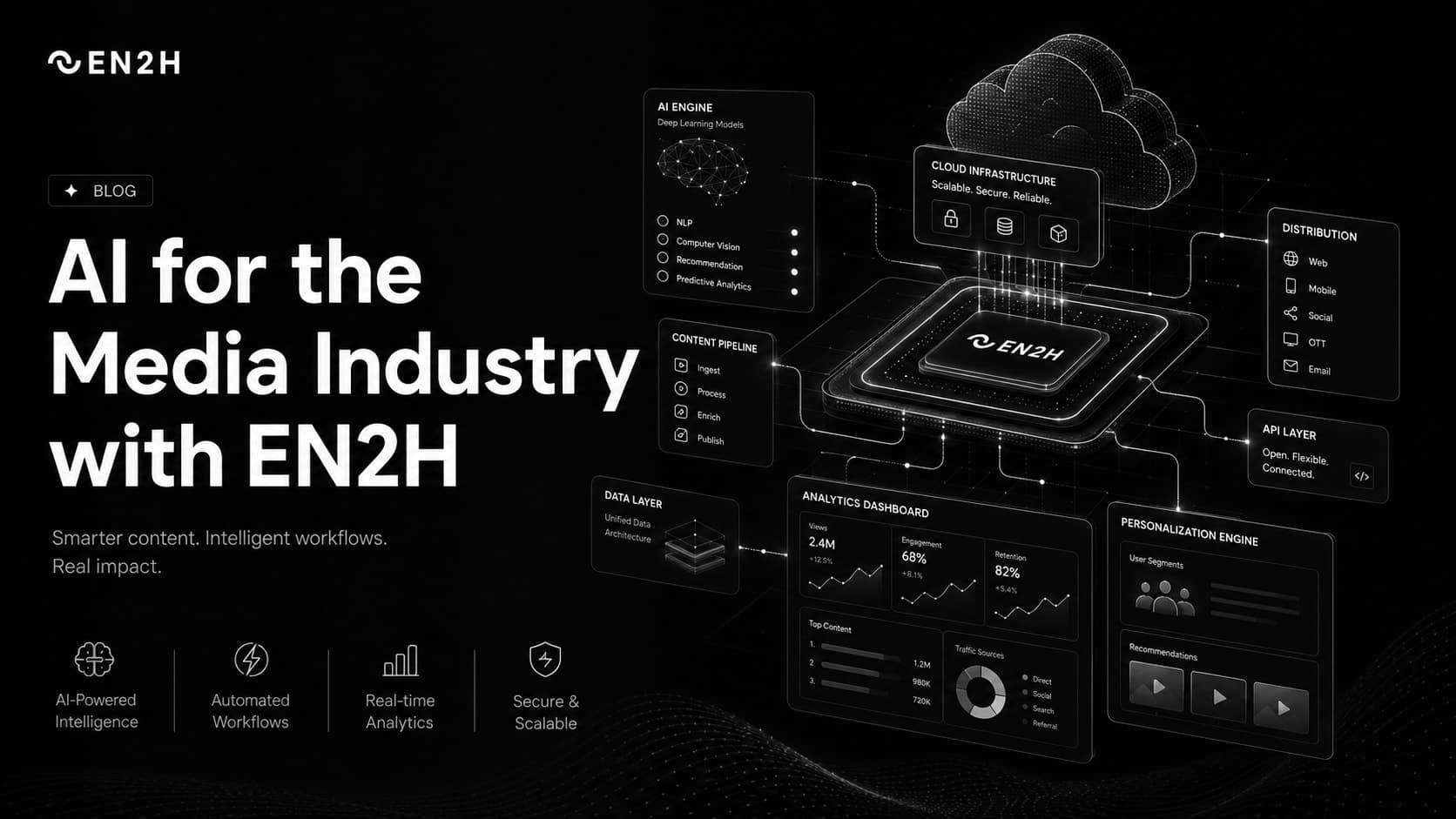
The media industry is evolving faster than ever before.
From content creation and audience engagement to analytics and distribution, Artificial Intelligence is transforming how modern media organizations operate, scale, and innovate.
At EN2H, we help media companies integrate AI strategically into their digital ecosystems to improve efficiency, automate workflows, enhance audience experiences, and unlock new growth opportunities.
AI is no longer just an experimental technology for media companies.
It is becoming a critical operational advantage.
The Evolution of the Modern Media Industry
The media industry has experienced one of the most significant technological transformations of the modern digital era. Over the past two decades, the shift from traditional publishing ecosystems to intelligent digital media platforms has fundamentally changed how content is created, distributed, consumed, and monetized.
In the past, media operations were largely driven by manual workflows and centralized production systems. Newsrooms, television networks, publishing houses, and advertising agencies relied heavily on human coordination across every stage of the content lifecycle. Tasks such as content categorization, editorial review, publishing management, audience segmentation, and advertisement optimization required extensive manual effort and operational resources.
Traditional media systems were designed for slower publishing cycles and limited distribution channels. Newspapers operated on daily publishing schedules, television followed fixed broadcasting timelines, and audience feedback was often delayed or difficult to measure accurately. Content discovery depended heavily on editors, static categories, or scheduled programming rather than intelligent personalization.
As digital platforms emerged, the volume of content increased exponentially. Media organizations began publishing across websites, mobile applications, streaming platforms, newsletters, podcasts, and social media ecosystems simultaneously. This created a level of operational complexity that traditional workflows were not designed to handle efficiently.
Modern audiences now consume media in highly dynamic and personalized ways. Users expect instant access to relevant content across multiple devices and platforms at any time of the day. They demand personalized recommendations, real-time updates, interactive experiences, and seamless digital performance. Attention spans have shortened while competition for engagement has intensified across every digital channel.
This shift created major challenges for media organizations:
Managing massive content libraries
Delivering personalized user experiences
Optimizing multi-platform distribution
Understanding audience behavior in real time
Scaling operational workflows efficiently
Maintaining engagement across fragmented digital ecosystems
Artificial Intelligence has emerged as the key technology enabling media organizations to adapt to this new environment.
AI-powered systems can process enormous volumes of data, analyze audience behavior patterns, automate repetitive operational tasks, and optimize content delivery at scale. Instead of relying entirely on manual editorial decisions, modern media platforms can now use intelligent systems to recommend content, automate publishing workflows, improve audience targeting, and generate actionable insights in real time.
For example, AI recommendation engines can analyze user reading behavior, watch history, engagement patterns, and search activity to deliver highly personalized content experiences. This improves audience retention, increases session duration, and enhances overall platform engagement.
Similarly, AI-driven analytics platforms help media companies identify trending topics, predict audience interests, optimize advertisement performance, and make faster editorial decisions based on live behavioral data rather than assumptions.
Content management systems are also evolving through AI integration. Tasks such as metadata generation, smart categorization, auto-tagging, transcription, language translation, and content summarization can now be automated, significantly reducing operational overhead while improving publishing efficiency.
At the same time, automation technologies are helping media organizations streamline complex workflows such as social media scheduling, notification orchestration, content moderation, advertisement targeting, and cross-platform publishing. These systems allow media teams to focus more on creativity, storytelling, and strategic growth rather than repetitive operational tasks.
The evolution of the media industry is no longer simply about moving from print to digital. It is about transitioning from static publishing systems to intelligent, scalable, AI-driven digital ecosystems.
Modern media organizations are increasingly becoming technology companies that rely on data infrastructure, cloud-native platforms, AI-powered analytics, automation systems, and scalable product engineering to remain competitive.
As audience expectations continue to evolve, Artificial Intelligence will play an even larger role in shaping the future of media through:
Intelligent personalization
Predictive audience engagement
Automated content workflows
Real-time analytics
Multi-platform optimization
AI-assisted journalism
Smart content discovery
Scalable media infrastructure
The organizations that successfully integrate AI into their operational and technological foundations will gain significant advantages in audience engagement, scalability, efficiency, and long-term digital growth.
At EN2H, we help media organizations modernize through scalable AI-first product engineering, intelligent automation, and enterprise-grade digital infrastructure designed for the future of modern media.

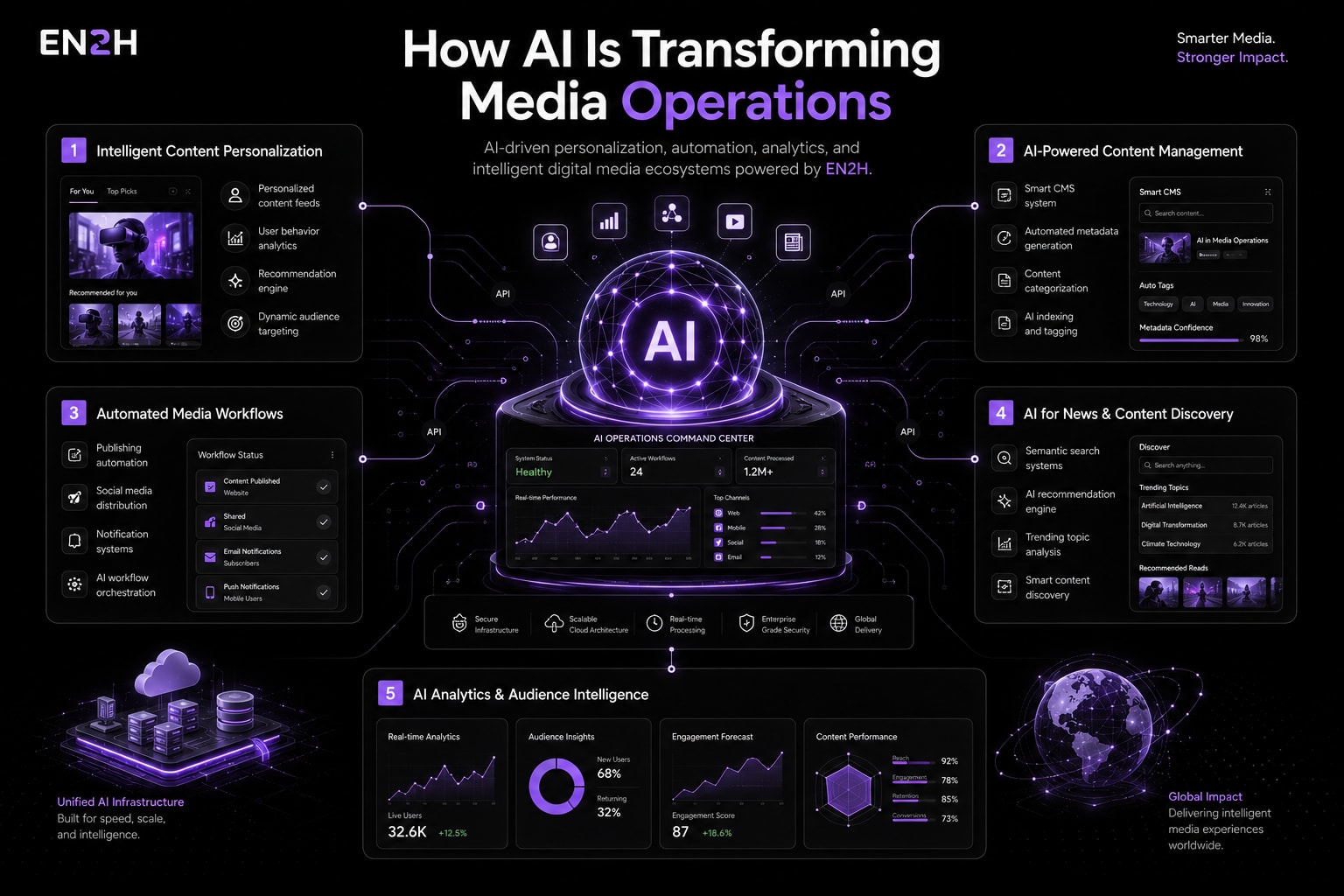
How AI Is Transforming Media Operations
Artificial Intelligence is fundamentally transforming how modern media organizations operate, scale, and engage with audiences. As digital ecosystems become more competitive and content consumption continues to accelerate, traditional media workflows are no longer sufficient to meet modern audience expectations.
Today’s media industry requires intelligent systems capable of processing massive amounts of data, automating operational workflows, optimizing audience engagement, and delivering highly personalized digital experiences in real time.
AI is becoming the technological foundation that enables media companies to modernize efficiently while remaining scalable and competitive.
1. Intelligent Content Personalization
Modern audiences no longer consume content in the same way as traditional media users. Instead of passively browsing static content feeds, users now expect highly personalized experiences tailored to their interests, behaviors, and consumption patterns.
AI-powered recommendation systems analyze large volumes of behavioral and engagement data to understand what individual users are most likely to consume. These systems can evaluate reading history, watch patterns, search activity, interaction behavior, engagement duration, click-through rates, and content preferences to continuously improve personalization accuracy.
As a result, media platforms can dynamically deliver content recommendations that feel more relevant, timely, and engaging for each individual user.
This level of personalization significantly improves platform performance by increasing user retention, boosting engagement, extending session durations, improving subscription conversion rates, and enhancing overall audience satisfaction.
Large-scale streaming platforms, digital news ecosystems, and modern media applications increasingly rely on AI-driven personalization engines to maintain audience engagement in highly competitive digital environments.
At EN2H, we help media organizations design scalable recommendation systems and personalization infrastructures that support long-term digital growth and intelligent audience engagement.
2. AI-Powered Content Management
Managing large-scale digital content ecosystems manually has become increasingly difficult for modern media organizations. Media companies now handle enormous volumes of articles, videos, podcasts, images, metadata, advertisements, and social content across multiple platforms simultaneously.
Traditional content management workflows often create operational bottlenecks due to repetitive manual processes such as content tagging, categorization, metadata management, indexing, transcription, and publishing coordination.
Artificial Intelligence helps automate these operational tasks through intelligent content management systems.
AI-powered CMS platforms can automatically generate metadata, classify content categories, optimize search indexing, detect duplicate content, summarize articles, generate transcripts, and improve content organization at scale.
These intelligent workflows significantly reduce operational overhead while improving publishing efficiency, discoverability, and platform scalability.
Modern media organizations are increasingly shifting toward AI-enhanced CMS ecosystems capable of supporting real-time content operations, automated workflows, and scalable digital publishing infrastructures.
3. Automated Media Workflows
Media operations involve a large number of repetitive processes that consume significant time and human resources. Tasks such as scheduling content, distributing posts across platforms, managing notifications, segmenting audiences, optimizing advertisements, and moderating content often require constant manual coordination.
AI-driven automation systems help streamline these workflows by reducing operational complexity and increasing efficiency.
Modern AI automation platforms can intelligently schedule publishing times based on audience behavior, automate multi-platform social media distribution, personalize notification systems, optimize advertising targeting, and assist with content moderation using machine learning models.
This level of automation allows media organizations to scale operations more efficiently while reducing dependency on manual administrative processes.
As a result, editorial teams, creators, and strategists can focus more on creativity, storytelling, innovation, and audience experience instead of repetitive operational management.
AI-driven workflow automation is becoming a major competitive advantage for modern digital media companies.
4. AI for News & Content Discovery
As digital content ecosystems continue to grow rapidly, discoverability has become one of the biggest challenges facing media organizations.
Users are exposed to massive volumes of content every day across websites, applications, streaming platforms, and social media channels. Without intelligent discovery systems, valuable content can easily become buried within large content libraries.
Artificial Intelligence improves content discovery by enabling more intelligent search and recommendation experiences.
AI-powered systems use semantic search technologies, intelligent indexing, behavioral analysis, trend detection, and contextual recommendation algorithms to help users find relevant content faster and more accurately.
Unlike traditional keyword-based search systems, AI-driven discovery engines understand contextual meaning, user intent, behavioral relevance, and engagement patterns.
This allows media platforms to provide smarter recommendations, surface trending topics dynamically, and create more engaging user journeys throughout the platform ecosystem.
Improved discoverability directly contributes to higher engagement, better content consumption, increased retention, and stronger audience satisfaction.
5. AI Analytics & Audience Intelligence
Data has become one of the most valuable assets within modern media organizations. However, raw data alone provides little value unless it can be transformed into meaningful insights that support strategic decision-making.
AI-driven analytics systems enable media companies to analyze audience behavior in far greater depth than traditional reporting tools.
Modern AI analytics platforms can provide predictive audience insights, engagement forecasting, user segmentation, behavioral pattern analysis, trend detection, and performance optimization recommendations in real time.
These systems help organizations understand:
Which content performs best
What audiences are most interested in
When engagement peaks occur
Which topics are trending
How user behavior evolves over time
What strategies improve retention and conversion
This intelligence enables editorial teams, product teams, marketing departments, and business leaders to make faster and more data-driven decisions.
AI and the Future of Digital Journalism
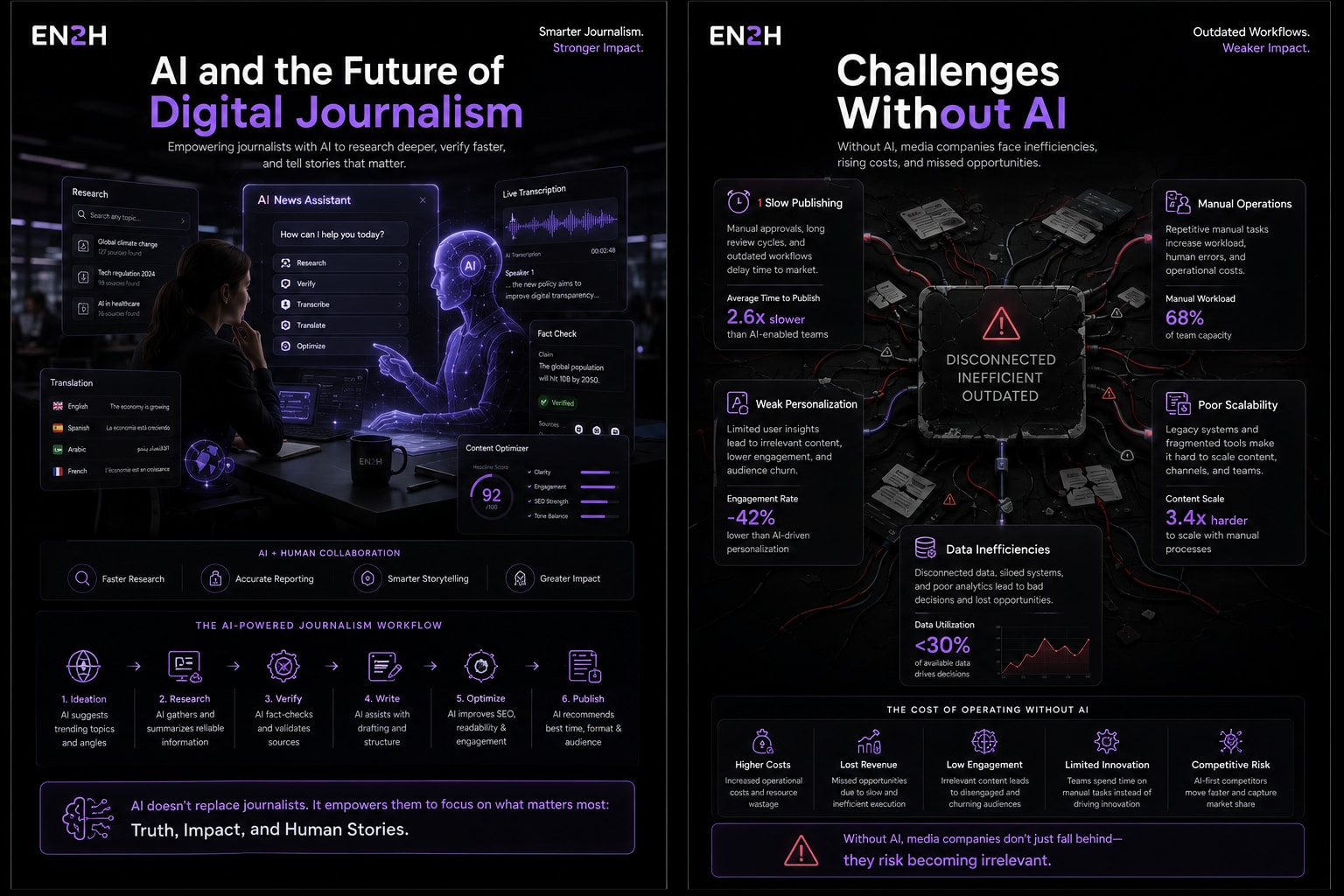
Artificial Intelligence is rapidly reshaping the future of digital journalism and modern newsroom operations. However, contrary to common misconceptions, AI is not replacing journalists, editors, or creators. Instead, AI is becoming a powerful support system that enhances operational efficiency, improves research capabilities, and streamlines complex media workflows.
Journalism remains deeply dependent on human creativity, critical thinking, ethical judgment, storytelling ability, and editorial integrity. These are areas where human expertise continues to play an irreplaceable role. What AI provides is the ability to reduce repetitive operational workloads and assist media professionals in managing the growing complexity of modern digital publishing ecosystems.
Modern newsrooms now operate within highly competitive real-time digital environments where audiences expect instant updates, multi-platform accessibility, personalized experiences, and continuous content delivery. Managing these expectations manually can create significant operational pressure for journalists and editorial teams.
AI technologies help address these challenges by supporting various stages of the journalism workflow.
For example, AI-powered research systems can assist journalists by analyzing large volumes of information quickly, identifying relevant trends, summarizing lengthy documents, and helping organize research materials efficiently. Fact-checking systems powered by AI can support verification workflows by detecting inconsistencies, identifying misinformation patterns, and improving content validation processes.
AI also plays a major role in content organization and publishing operations. Intelligent systems can automate transcription for interviews and broadcasts, generate metadata, categorize articles, optimize search indexing, and provide multilingual translation support for global audiences.
In addition, AI-driven audience engagement systems help media organizations better understand how users interact with content. Analytics engines can identify engagement patterns, optimize content distribution timing, personalize user experiences, and improve overall audience retention strategies.
Rather than replacing journalism, AI allows journalists and media professionals to focus more on high-value work such as investigative reporting, storytelling, editorial strategy, creative production, and audience relationship building.
The future of digital journalism will likely involve stronger collaboration between human expertise and intelligent systems, where AI enhances operational capabilities while humans continue leading creativity, ethics, and narrative development.
Challenges Media Companies Face Without AI
As digital ecosystems continue to evolve rapidly, media organizations that fail to modernize their operations increasingly struggle to remain competitive. Traditional publishing infrastructures and manual workflows often create operational bottlenecks that limit scalability, reduce efficiency, and weaken audience engagement.
One of the biggest challenges facing media companies without AI integration is slow publishing workflows. Modern audiences expect real-time content delivery across multiple digital platforms, but manual processes can delay production, distribution, and optimization activities.
Audience retention also becomes more difficult without intelligent personalization systems. Users today expect platforms to understand their interests and deliver highly relevant content experiences. Without AI-powered recommendation engines and behavioral analytics, many media organizations struggle to maintain long-term audience engagement.
Manual operational overload is another major issue. Editorial teams often spend significant amounts of time managing repetitive tasks such as categorization, metadata tagging, social media scheduling, content moderation, analytics reporting, and publishing coordination. These operational inefficiencies reduce productivity and limit innovation capacity.
As content libraries grow, content management complexity also increases significantly. Without AI-assisted systems, organizing, searching, indexing, and optimizing large-scale media ecosystems becomes increasingly difficult and resource-intensive.
Data inefficiencies further impact decision-making. Many organizations collect large amounts of audience data but lack intelligent systems capable of transforming that information into actionable insights. This limits their ability to optimize engagement strategies, identify trends, and improve content performance effectively.
Scalability also becomes a major concern. As media platforms expand across multiple channels and audience segments, manual systems often struggle to support increasing operational demands efficiently.
In today’s highly competitive digital landscape, AI-driven operations are no longer optional for many media organizations. They are becoming essential for sustainable growth, operational efficiency, audience engagement, and long-term digital transformation.
How EN2H Helps Media Companies
At EN2H, we help media organizations modernize through scalable AI-first digital systems designed specifically for the future of intelligent media operations.
Our approach combines product engineering, AI integration, scalable cloud infrastructure, and modern digital architecture to create media ecosystems capable of supporting long-term growth and operational efficiency.
We develop AI-powered CMS platforms that help media organizations manage large-scale content operations more intelligently through automation, smart categorization, metadata optimization, and scalable publishing workflows.
Our recommendation systems enable media companies to deliver personalized user experiences by analyzing audience behavior, engagement patterns, and content preferences in real time. These systems improve retention, increase engagement, and create more intelligent content discovery experiences.
EN2H also designs audience analytics dashboards and business intelligence infrastructures that transform media data into actionable insights. Through AI-driven analytics systems, organizations can better understand audience behavior, optimize performance, predict engagement trends, and make more strategic editorial decisions.
Automation is another major focus within our engineering approach. We build automated publishing workflows that streamline operations such as scheduling, notifications, social media distribution, audience segmentation, and content management processes. This reduces manual workload while improving operational scalability.
In addition, we help organizations build scalable media data infrastructures and AI-powered search systems capable of supporting modern multi-platform media ecosystems.
Our cloud-native engineering approach ensures that media platforms remain scalable, secure, and performance-optimized even as traffic volumes, audience engagement, and content operations continue to grow.
At EN2H, we believe the future of media belongs to organizations capable of combining intelligent automation, scalable digital infrastructure, and human creativity into unified AI-powered media ecosystems designed for long-term innovation and growth.
The Future of AI in Media
The future media ecosystem will be increasingly driven by:
Intelligent personalization
AI-assisted production
Real-time analytics
Automated workflows
Predictive audience engagement
Multi-modal content systems
AI-powered search & discovery
Media companies that adapt early will gain major advantages in scalability, audience retention, and operational efficiency.
Final Thoughts
Artificial Intelligence is reshaping the media industry from infrastructure to user experience.
Organizations that strategically integrate AI can:
Improve efficiency
Scale faster
Enhance personalization
Increase engagement
Reduce operational costs
Build smarter digital ecosystems
At EN2H, we help media organizations build scalable AI-first platforms designed for the future of digital media.
The next generation of media companies will not simply publish content.
They will operate through intelligent digital ecosystems powered by AI.
