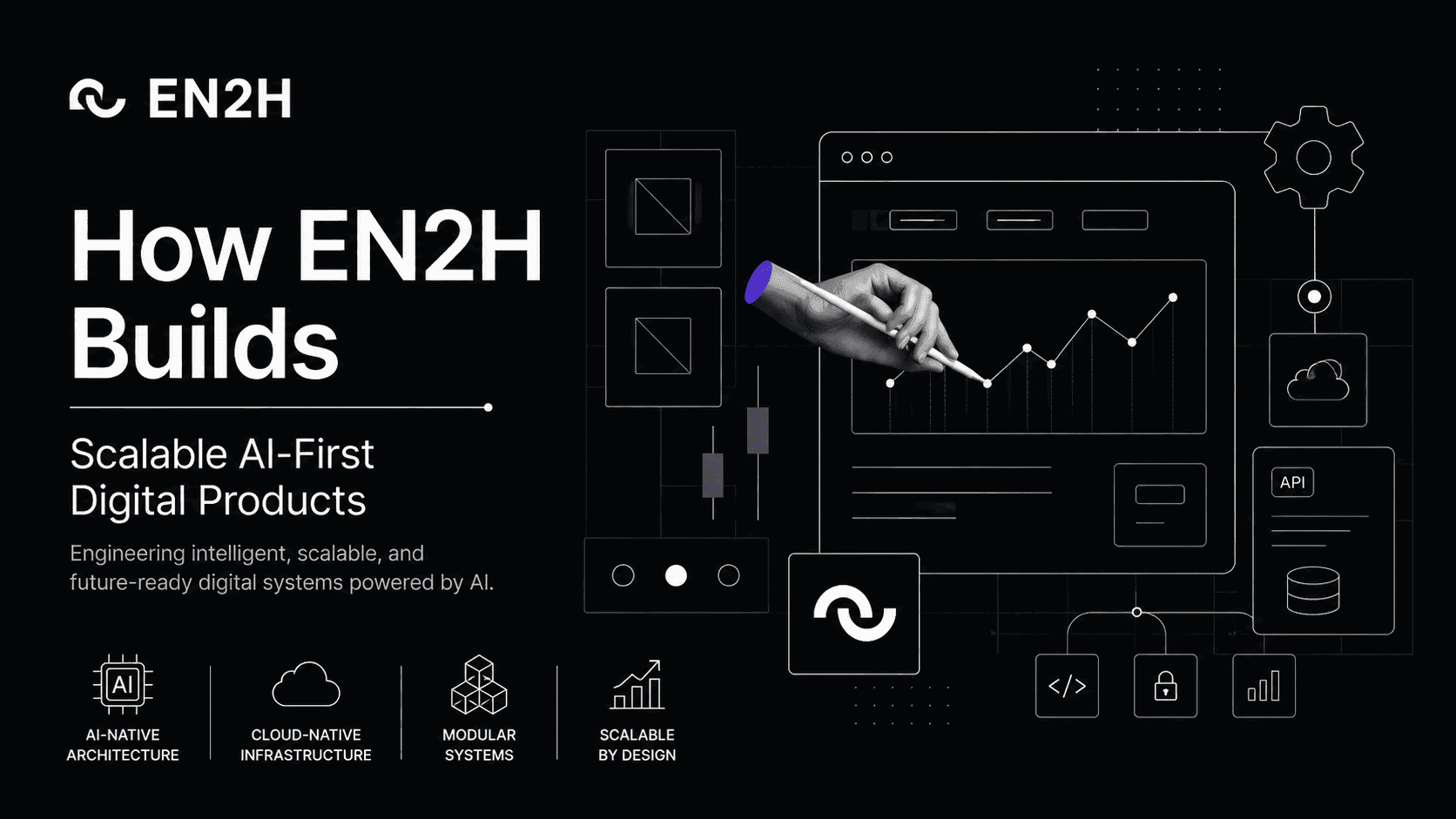
How EN2H Builds Scalable AI-First Digital Products
Artificial Intelligence is no longer just a competitive advantage.
It is becoming the foundation of how modern digital products are designed, operated, and scaled.
At EN2H, we believe AI should not be treated as an isolated feature added at the end of development. Instead, AI must be integrated into the core architecture, workflows, and business logic of digital products from the very beginning.
This is what we call an AI-First Product Engineering Approach.
What Does “AI-First” Actually Mean?
Many businesses integrate AI as an extra layer:
A chatbot added after launch
A recommendation engine plugged into an existing platform
Analytics dashboards generated from disconnected systems
But AI-first systems are different.
An AI-first digital product is designed around:
Intelligent automation
Real-time decision making
Data-driven workflows
Predictive systems
Continuous learning and optimization
This approach changes how products are architected, scaled, and maintained.
At EN2H, we focus on building systems where AI is embedded into the operational DNA of the platform — not attached as a marketing feature.
Our Core Philosophy
Every scalable AI product needs four foundational layers:
1. Scalable System Architecture
AI systems require more than a frontend and backend.
They require:
High-performance APIs
Modular microservices
Data pipelines
Queue systems
Caching strategies
GPU-ready infrastructure
Real-time processing capabilities
At EN2H, we design systems using modern cloud-native architectures that can scale from MVP to enterprise-level usage without rebuilding the entire platform later.
Typical technologies include:
Next.js
NestJS
FastAPI
PostgreSQL
Redis
Docker
AWS infrastructure
Cloudflare/CDN optimization
This foundation ensures the product remains stable as AI workloads increase.
2. Data-Centric Engineering
AI products are only as good as the data behind them.
Most companies focus only on models.
We focus on the complete data lifecycle.
This includes:
Data collection pipelines
Validation systems
Data normalization
Real-time processing
Storage optimization
Privacy and security layers
Analytics infrastructure
Without proper data engineering, even advanced AI models fail in production environments.
EN2H builds systems where data continuously improves product intelligence over time.
3. Modular AI Integration
AI evolves rapidly.
What works today may become outdated within months.
Because of this, we avoid tightly coupling AI models directly into product infrastructure.
Instead, we design modular AI layers that allow:
Model replacement
Multi-model orchestration
Experimentation
Fine-tuning
Explainability integration
Independent AI scaling
This makes future upgrades significantly easier and reduces long-term technical debt.
For example, a recommendation engine, NLP model, or fraud detection system can evolve independently without rebuilding the core application.
4. Human-Centered Product Experience
AI should improve user experience — not complicate it.
Many AI products fail because they prioritize technology over usability.
At EN2H, we focus heavily on:
UX architecture
Explainable AI experiences
Clear workflows
Performance optimization
Trust and transparency
Accessibility
Cross-platform consistency
The goal is to make AI feel natural inside the product experience.
Users should benefit from intelligence without needing to understand the complexity behind it.
Our AI Product Development Process
Phase 01 — Discovery & Strategy
Before writing code, we identify:
Business goals
User workflows
Automation opportunities
Data availability
Scalability risks
AI feasibility
Long-term operational costs
This stage prevents businesses from investing in AI features that provide little real-world value.
Phase 02 — System Design
We create:
Technical architecture
Database structure
AI service flow
API ecosystem
Security models
Deployment strategies
Monitoring plans
This stage ensures scalability before development begins.
Phase 03 — MVP Engineering
We build production-grade MVPs focused on:
Fast iteration
Core business validation
AI workflow testing
User feedback collection
Infrastructure readiness
The objective is not just launching quickly — but launching correctly.
Phase 04 — AI Optimization & Scaling
Once the platform gains users and data:
AI models improve
Analytics become more valuable
Automation expands
Infrastructure scales
Performance bottlenecks are optimized
This stage transforms the product from a simple software platform into an intelligent operational system.
Industries Where AI-First Systems Create Massive Impact
AI-first product engineering can transform:
Media & content platforms
Education systems
Healthcare operations
Financial technology
E-commerce ecosystems
Customer support platforms
Enterprise workflow automation
Smart analytics platforms
Recommendation engines
Fraud detection systems
The key is not simply using AI — but integrating it strategically into business operations.
Why Scalability Matters in AI Products
Many AI startups fail after initial traction because their systems were never designed for scale.
Common problems include:
Expensive infrastructure costs
Slow AI inference
Poor API architecture
Weak database optimization
Model deployment failures
Lack of monitoring
High operational complexity
At EN2H, scalability is considered from day one.
We engineer systems that can evolve with growing users, larger datasets, and more advanced AI capabilities.
The Future of Digital Products Is AI-Native
The next generation of digital products will not simply “use AI.”
They will operate through AI-driven decision systems, automation pipelines, intelligent personalization, and adaptive workflows.
Businesses that prepare early will gain significant advantages in:
Operational efficiency
User retention
Automation
Cost reduction
Data intelligence
Product innovation
AI is becoming infrastructure — not just functionality.
Final Thoughts
Building scalable AI-first digital products requires more than integrating machine learning models into applications.
It requires:
Strategic product thinking
Strong system architecture
Scalable engineering
Data infrastructure
User-centered design
Continuous optimization
At EN2H, we combine product engineering, AI integration, and scalable architecture to help businesses build intelligent digital systems designed for long-term growth.
The future belongs to companies that can transform ideas into scalable intelligent products — efficiently, securely, and strategically.
