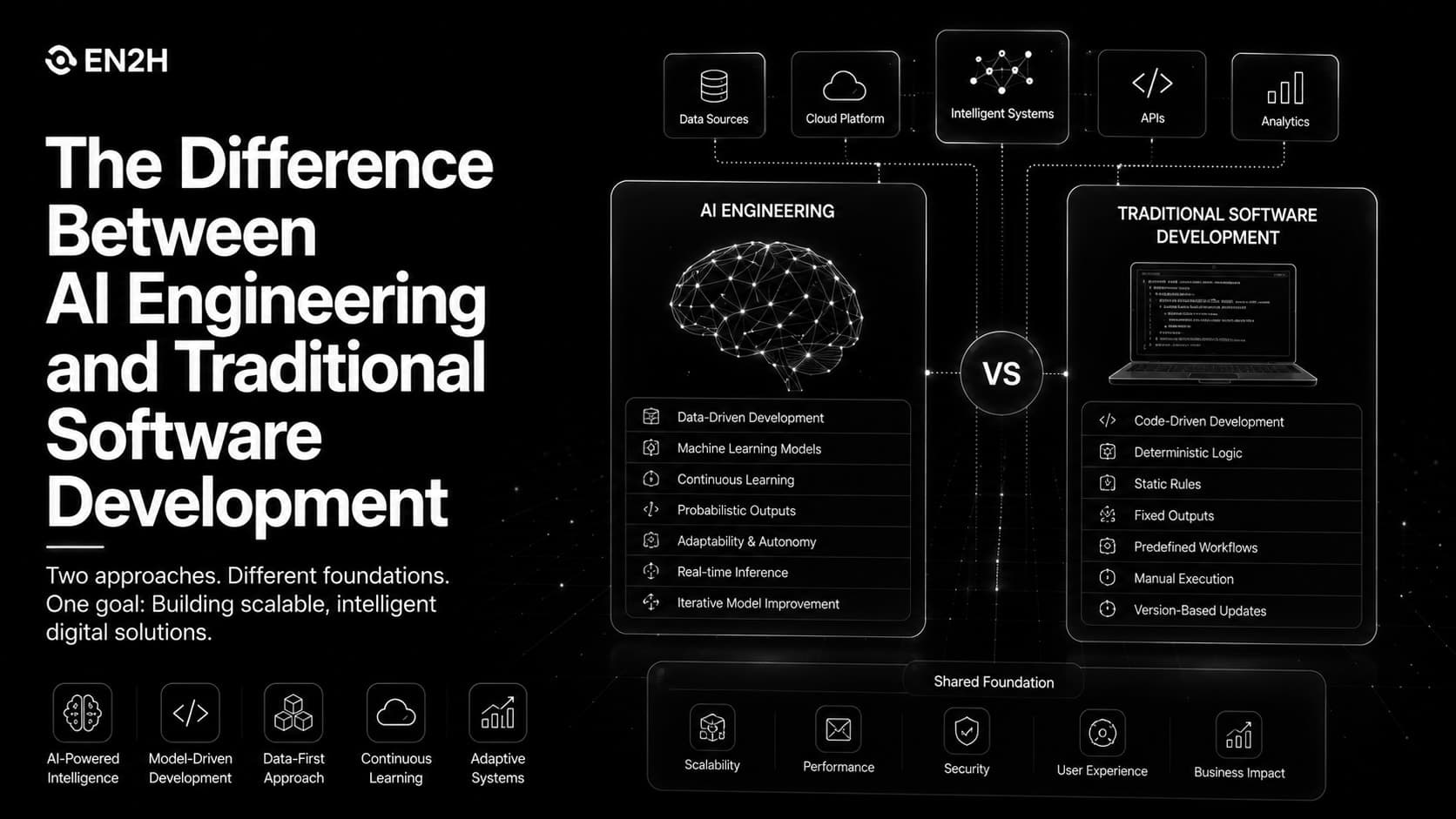
The Difference Between AI Engineering and Traditional Software Development
Software development has evolved significantly over the past decade.
Traditional software systems once focused primarily on fixed logic, predefined workflows, and rule-based applications. Today, modern digital products increasingly rely on Artificial Intelligence, machine learning models, intelligent automation, predictive analytics, and adaptive systems capable of learning from data.
This evolution has created a new engineering discipline known as AI Engineering.
Although traditional software development and AI Engineering share some technical foundations, they differ significantly in architecture, workflows, infrastructure requirements, scalability challenges, and operational thinking.
At EN2H, we help businesses build scalable AI-first digital systems that combine modern product engineering, cloud infrastructure, intelligent automation, and operational scalability.
Understanding the difference between AI Engineering and traditional software development is becoming increasingly important for modern businesses adopting AI technologies.
What Is Traditional Software Development?
Traditional software development focuses on building systems using predefined logic and structured programming rules.
In traditional applications:
Developers define exact instructions
Systems follow predictable workflows
Outputs are determined by programmed conditions
Applications operate through fixed business rules
Examples include:
E-commerce websites
CMS platforms
ERP systems
Banking applications
Mobile apps
CRM systems
Traditional software systems are typically deterministic.
This means:
The same input generally produces the same output based on predefined logic.
For example:
Login authentication systems
Payment gateways
CRUD operations
Form validation
Inventory systems
all rely on explicit programming rules.
What Is AI Engineering?
AI Engineering focuses on building intelligent systems capable of:
Learning from data
Making predictions
Understanding patterns
Automating decisions
Processing unstructured information
Adapting dynamically
Instead of relying entirely on fixed programming logic, AI systems use:
Machine learning models
Neural networks
Data pipelines
AI inference systems
Training workflows
Statistical learning techniques
AI Engineering combines:
Software engineering
Data engineering
Machine learning
Cloud infrastructure
Model optimization
Operational AI workflows
This creates systems capable of intelligent behavior rather than fixed rule execution.
The Core Difference Between Both Approaches
The biggest difference is how decisions are made.
Traditional software:
Uses predefined logic
Operates through rules
Produces predictable outputs
AI systems:
Learn patterns from data
Generate probabilistic outputs
Adapt through training and optimization
Traditional systems are programmed.
AI systems are trained.
Traditional Software Development Workflow
Traditional software development generally follows workflows such as:
Requirements gathering
UI/UX design
Backend development
Frontend development
Database design
API integration
Testing
Deployment
The main focus is:
System functionality
Reliability
Performance
Security
Scalability
Most logic is explicitly written by developers.
AI Engineering Workflow
AI Engineering introduces additional operational layers.
AI workflows often include:
Data collection
Data preprocessing
Feature engineering
Model training
Validation
Hyperparameter tuning
Inference optimization
Continuous model monitoring
This makes AI systems significantly more data-dependent.
In AI Engineering:
Data becomes part of the software architecture itself.
Data Dependency Differences
Traditional software systems can operate effectively with structured databases and predefined workflows.
AI systems depend heavily on:
Large datasets
Data quality
Continuous training
Real-world feedback loops
Without quality data:
AI systems become unreliable.
This is one of the biggest operational differences between AI Engineering and traditional software development.
Infrastructure Requirements
Traditional software applications generally require:
Web servers
Databases
APIs
Authentication systems
Storage systems
AI Engineering often requires additional infrastructure such as:
GPU computing
Model inference systems
Data pipelines
Distributed processing
AI orchestration systems
Vector databases
Model monitoring systems
Cloud-native infrastructure becomes significantly more important for AI systems.
At EN2H, scalable AI ecosystems are commonly built using:
AWS
Docker
Kubernetes
FastAPI
Cloud-native architectures
AI-ready infrastructure
Predictability vs Probabilistic Systems
Traditional software systems are predictable.
If a developer defines:
IF user clicks button → execute action
the system behaves consistently.
AI systems behave differently.
AI outputs are often probabilistic.
For example:
An AI model may predict:
92% confidence
78% confidence
Multiple possible outputs
AI systems require evaluation metrics such as:
Accuracy
Precision
Recall
F1-score
ROC-AUC
EER
Traditional applications usually do not require these forms of probabilistic evaluation.
Scalability Differences
Traditional software scaling focuses mainly on:
User traffic
Database optimization
API performance
Infrastructure scaling
AI systems introduce additional scalability challenges:
Model inference performance
GPU resource management
AI latency optimization
Large dataset processing
Distributed model serving
AI systems are computationally heavier than traditional applications.
Maintenance Differences
Traditional software maintenance typically involves:
Bug fixes
Feature updates
Security patches
Infrastructure optimization
AI systems require:
Model retraining
Data updates
Drift monitoring
Inference optimization
Continuous evaluation
AI models can degrade over time if real-world data changes.
This is known as model drift.
AI Engineering Requires Multi-Disciplinary Thinking
Traditional software development often focuses mainly on engineering execution.
AI Engineering requires collaboration between:
Software engineers
Data engineers
ML engineers
Cloud engineers
Product teams
Business analysts
AI systems involve both technical and operational intelligence layers.
User Experience Differences
Traditional applications provide:
Fixed user experiences
Static workflows
Rule-based interactions
AI systems can create:
Personalized experiences
Adaptive interfaces
Intelligent recommendations
Predictive interactions
Conversational systems
This changes how users interact with digital products.
AI Engineering and Product Engineering
Modern AI products require more than just AI models.
Successful AI systems also require:
Strong architecture
Scalable APIs
Operational workflows
Real-time analytics
Business Intelligence systems
Monitoring infrastructure
User-centered experiences
At EN2H, we combine AI Engineering with modern Product Engineering strategies to create scalable intelligent digital ecosystems.
Examples of Traditional vs AI Systems
Traditional Software Examples
Banking systems
CMS platforms
E-commerce checkout systems
Inventory management
Authentication systems
AI Engineering Examples
Recommendation systems
AI chat systems
Fraud detection
Predictive analytics
Voice recognition systems
Computer vision platforms
AI Agents
Why Businesses Need to Understand the Difference
Many organizations mistakenly believe AI is simply another software feature.
In reality:
AI systems require:
Different infrastructure
Different workflows
Different operational strategies
Different scalability planning
Businesses adopting AI without understanding these differences often face:
Poor scalability
Weak AI performance
Infrastructure bottlenecks
Operational inefficiencies
Strategic AI adoption requires proper engineering foundations.
The Future of AI Engineering
AI Engineering is rapidly becoming one of the most important fields in modern technology.
The future will increasingly include:
AI-powered applications
Autonomous systems
Intelligent automation
AI Agents
Predictive business systems
Multi-agent operational ecosystems
AI Engineering will continue merging with:
Product Engineering
Cloud infrastructure
Business Intelligence
Data Engineering
Automation systems
Final Thoughts
Traditional software development and AI Engineering both play critical roles in modern digital ecosystems.
Traditional software provides:
Stability
Structure
Reliability
Business workflows
AI Engineering adds:
Intelligence
Adaptability
Automation
Predictive capabilities
Modern businesses increasingly require both disciplines working together.
At EN2H, we help organizations build scalable AI-first digital systems that combine intelligent automation, cloud-native infrastructure, Business Intelligence, and modern product engineering strategies.
The future of digital transformation will belong to businesses that can successfully combine software engineering with operational intelligence.
