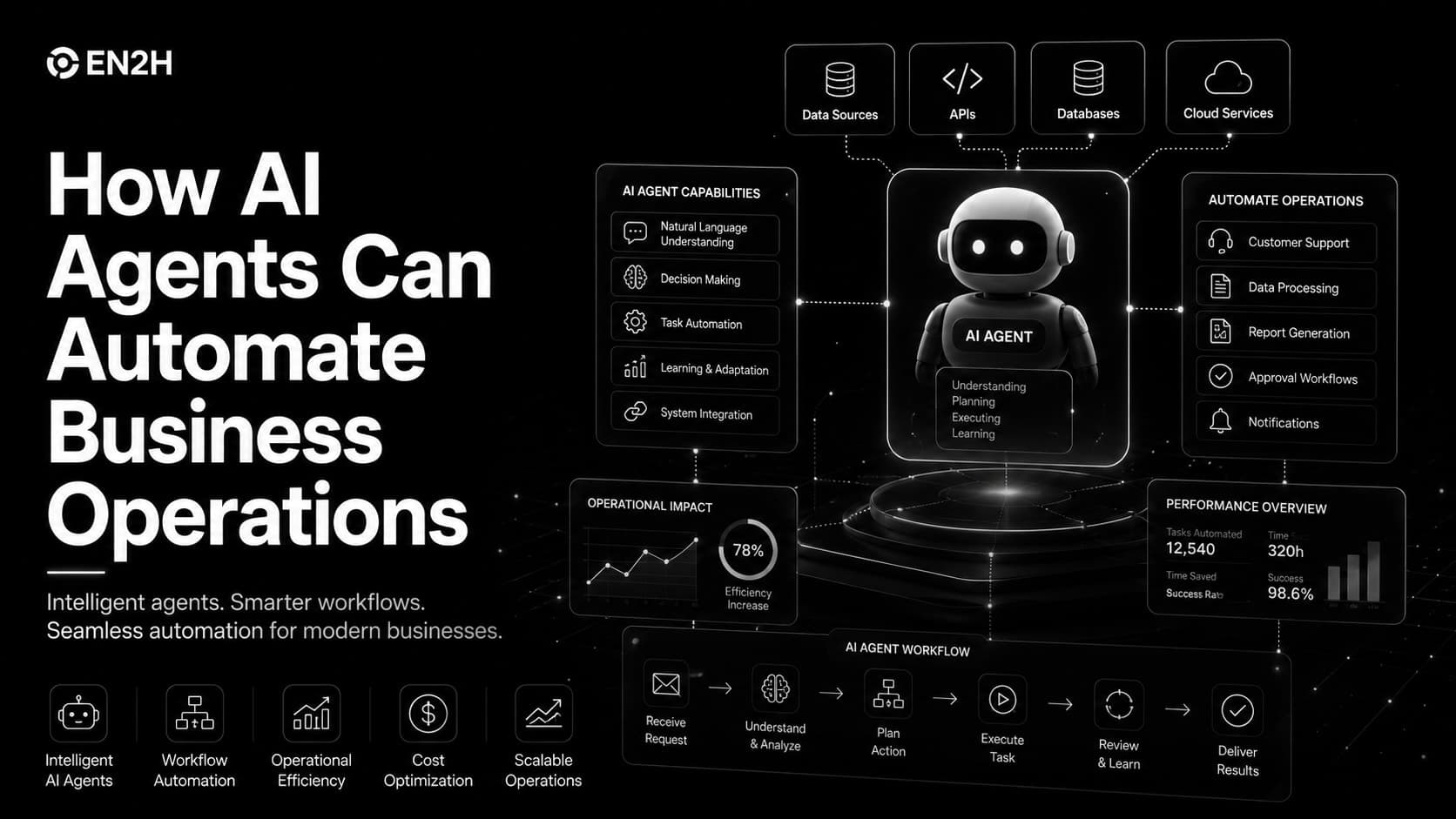
How AI Agents Can Automate Business Operations
Modern businesses are under constant pressure to operate faster, reduce operational costs, improve efficiency, and deliver better customer experiences.
As organizations scale, manual workflows become increasingly difficult to manage. Teams spend significant amounts of time handling repetitive tasks, operational coordination, reporting, approvals, customer interactions, and data processing activities.
This is where AI Agents are beginning to transform modern business operations.
AI Agents are not simply chatbots or automation tools. They are intelligent systems capable of understanding tasks, processing information, making decisions, interacting with software systems, and automating workflows with minimal human intervention.
At EN2H, we help organizations build scalable AI-powered operational systems that improve automation, efficiency, analytics, and intelligent decision-making across business ecosystems.
AI Agents are becoming one of the most important technologies driving the future of operational automation.
What Are AI Agents?
AI Agents are intelligent software systems designed to perform tasks autonomously based on goals, instructions, workflows, and real-time data.
Unlike traditional automation systems that follow fixed rules, AI Agents can:
Understand context
Process language
Analyze information
Make decisions
Interact with APIs and systems
Execute workflows dynamically
Learn from operational patterns
AI Agents combine:
Artificial Intelligence
Automation
Workflow orchestration
Decision-making systems
Real-time data processing
This allows businesses to automate more complex operational processes than traditional software automation tools.
Why Businesses Are Interested in AI Agents
Modern organizations face several operational challenges:
Repetitive manual tasks
Slow operational workflows
High operational overhead
Fragmented systems
Delayed reporting
Customer support bottlenecks
Increasing workload complexity
AI Agents help solve these problems by creating intelligent operational workflows capable of reducing manual intervention.
Businesses are increasingly adopting AI Agents because they can:
Improve efficiency
Reduce operational costs
Increase scalability
Improve response times
Support decision-making
Automate repetitive processes
Enhance customer experiences
AI Agents are especially valuable for businesses managing large amounts of operational data and repetitive workflows.
How AI Agents Work
AI Agents typically operate through several key components.
Input Processing
AI Agents receive information from:
User requests
APIs
Databases
Documents
Emails
Dashboards
Business systems
The agent interprets the context and identifies what action is required.
Decision-Making Logic
The AI Agent analyzes:
Business rules
Workflow logic
User intent
Operational data
System conditions
It then determines the most appropriate action based on predefined goals and contextual understanding.
System Interaction
Modern AI Agents can interact with:
CRMs
ERP systems
Databases
APIs
Analytics platforms
Cloud services
Communication tools
This allows agents to execute operational tasks automatically.
Continuous Workflow Execution
AI Agents can:
Monitor systems continuously
Trigger automated workflows
Generate reports
Send notifications
Update records
Process requests
Escalate issues when necessary
This creates highly efficient operational ecosystems.
Business Operations AI Agents Can Automate
AI Agents can support automation across many operational areas.
Customer Support Automation
AI Agents can:
Respond to customer inquiries
Handle FAQs
Route support tickets
Summarize conversations
Escalate complex issues
Provide 24/7 assistance
This improves response times while reducing support workload.
Internal Workflow Automation
Businesses can automate:
Approval workflows
Task assignments
Reporting systems
Internal notifications
Document processing
Operational coordination
AI Agents help reduce repetitive administrative tasks.
Sales & Lead Management
AI Agents can:
Qualify leads
Analyze customer behavior
Schedule follow-ups
Generate CRM updates
Prioritize opportunities
Track customer interactions
This improves sales operational efficiency.
Business Intelligence & Reporting
AI Agents can:
Analyze operational data
Generate dashboards
Create reports automatically
Identify trends
Detect anomalies
Monitor KPIs
This helps organizations improve decision-making speed.
Content & Media Operations
AI Agents can assist with:
Content organization
Metadata generation
Publishing workflows
AI-assisted content recommendations
Audience analytics
Media automation
This is especially valuable for modern digital media ecosystems.
HR & Administrative Operations
AI Agents can automate:
Employee onboarding workflows
Internal communication systems
Meeting coordination
Document validation
Attendance tracking
Policy assistance
This reduces administrative workload significantly.
Benefits of AI Agent Automation
Improved Operational Efficiency
AI Agents reduce repetitive manual tasks and allow teams to focus on higher-value strategic work.
Faster Response Times
AI-powered workflows operate continuously and respond much faster than manual systems.
Scalability
Businesses can scale operations without increasing manual workload at the same rate.
Reduced Operational Costs
Automation reduces time spent on repetitive operational processes.
Better Decision-Making
AI Agents can process large amounts of data and provide intelligent operational insights.
Improved Customer Experience
Faster support responses and intelligent workflows improve customer satisfaction.
AI Agents vs Traditional Automation
Traditional automation systems rely heavily on fixed rules and predefined workflows.
AI Agents differ because they can:
Understand natural language
Adapt to context
Handle dynamic workflows
Make intelligent decisions
Process unstructured information
This makes AI Agents significantly more flexible and scalable for modern operational environments.
The Role of Cloud Infrastructure in AI Agents
AI Agents require scalable infrastructure to operate effectively.
Modern AI Agent systems often depend on:
Cloud-native architecture
APIs
Real-time processing
AI inference systems
Databases
Workflow orchestration systems
Platforms such as:
AWS
Cloudflare
Docker
Kubernetes
Scalable databases
play important roles in supporting AI operational ecosystems.
At EN2H, we design AI systems with scalability and operational performance in mind.
AI Agents and Business Intelligence
AI Agents become even more powerful when integrated with Business Intelligence systems.
This allows agents to:
Analyze operational trends
Generate predictive insights
Identify anomalies
Recommend actions
Support strategic planning
Combining AI Agents with analytics systems creates intelligent operational ecosystems capable of continuous optimization.
Challenges Businesses Face When Implementing AI Agents
Although AI Agents offer major advantages, businesses still face several implementation challenges.
Poor Data Infrastructure
AI systems require reliable and structured operational data.
Weak Workflow Design
Poorly designed workflows reduce automation effectiveness.
Over-Complex Automation
Businesses sometimes attempt to automate too much too early.
System Integration Complexity
AI Agents often need integration with multiple platforms and operational systems.
Scalability Issues
Without proper infrastructure, AI Agent systems become difficult to maintain and scale.
At EN2H, we help organizations implement AI automation strategically while focusing on scalability, usability, and operational value.
EN2H’s Approach to AI Agent Systems
At EN2H, we design AI-powered operational ecosystems focused on:
Intelligent automation
Workflow optimization
Scalable architecture
Cloud-native systems
AI integration
Operational analytics
Business Intelligence
User-centered experiences
Our AI Agent systems are designed to improve operational efficiency while maintaining flexibility and scalability for future growth.
Industries That Benefit From AI Agent Automation
AI Agents create value across many industries.
Media & Publishing
Content workflows
Audience analytics
AI-assisted publishing
Education
Student support automation
Learning workflows
Administrative automation
Enterprise Operations
Workflow automation
Operational reporting
Internal process optimization
Retail & E-Commerce
Customer support
Inventory workflows
Personalized recommendations
Healthcare
Administrative coordination
Reporting workflows
Operational analytics
Financial Services
Reporting automation
Operational monitoring
Risk analysis support
The Future of AI Agents
AI Agents are expected to become a major part of future business operations.
The next generation of AI operational systems will increasingly include:
Autonomous workflows
Intelligent orchestration
AI-driven decision support
Multi-agent collaboration systems
Real-time analytics integration
Personalized operational automation
Businesses that adopt intelligent automation early will gain major advantages in efficiency, scalability, and operational intelligence.
Final Thoughts
AI Agents are transforming how modern organizations operate.
They help businesses:
Automate repetitive tasks
Improve operational efficiency
Scale workflows intelligently
Enhance customer experiences
Reduce operational complexity
Improve decision-making
AI Agents are not replacing businesses.
They are helping businesses become more intelligent operationally.
At EN2H, we help organizations build scalable AI-powered systems designed for automation, analytics, operational intelligence, and future-ready digital transformation.
The future of business operations will increasingly be driven by intelligent AI-powered ecosystems capable of learning, adapting, and automating at scale.
