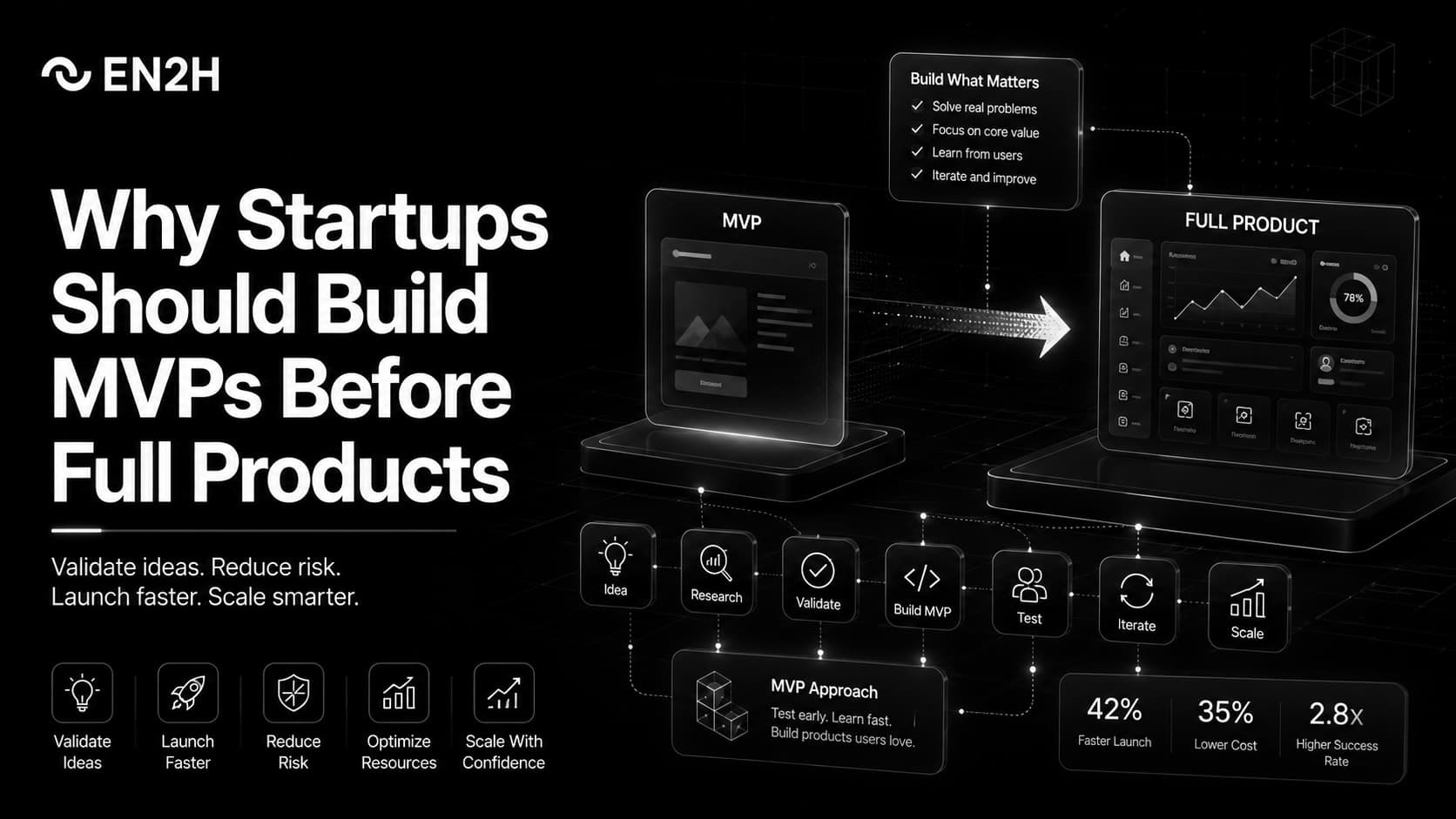
Why Startups Should Build MVPs Before Full Products
Building a startup is not only about having a great idea.
Many founders believe success comes from building the most advanced product with every possible feature included from the beginning. In reality, this approach often creates unnecessary complexity, high development costs, delayed launches, and increased business risk.
One of the biggest reasons startups fail is not because they cannot build products — but because they build products nobody truly needs.
This is why modern startups increasingly focus on building MVPs before developing full-scale products.
At EN2H, we help startups and businesses build scalable MVPs that validate ideas, reduce development risk, accelerate market entry, and create strong foundations for future growth.
An MVP is not about building a “small” product.
It is about building the right product strategically.
What Is an MVP?
MVP stands for Minimum Viable Product.
An MVP is the most simplified version of a product that solves a core problem for users while requiring the minimum amount of development effort.
The goal of an MVP is to:
Validate business ideas
Test market demand
Gather user feedback
Reduce development risk
Launch faster
Learn before scaling
Instead of spending years building a fully-featured platform, startups can release a focused version of the product and improve it based on real-world usage and customer behavior.
Modern successful companies such as:
Airbnb
Dropbox
Uber
Facebook
Instagram
all started with simplified MVP versions before evolving into large-scale platforms.
Why Building Full Products Too Early Is Risky
Many startups attempt to launch with:
Complex systems
Large feature sets
Advanced infrastructure
Expensive development cycles
Multiple integrations
Large operational costs
Without validating market demand first.
This creates several major risks.
High Development Costs
Building a full-scale platform requires:
Engineering resources
UI/UX design
Infrastructure setup
Testing
Maintenance
Marketing support
For early-stage startups, this can quickly consume limited budgets before achieving product-market fit.
Delayed Market Entry
The longer startups spend building, the longer they delay learning from real users.
Many founders spend months or years developing features customers may never use.
Meanwhile, competitors may launch faster and capture market attention earlier.
Increased Product Complexity
Early-stage startups often do not fully understand:
User behavior
Customer priorities
Market expectations
Operational workflows
Building too many features too early usually creates unnecessary complexity and technical debt.
Higher Failure Risk
Without validating assumptions, startups risk building products that fail to solve meaningful problems.
MVPs reduce this risk significantly by testing the business idea before large-scale investment.
Benefits of Building an MVP First
Faster Validation
An MVP allows startups to quickly validate:
Market demand
User interest
Product usability
Pricing models
Business assumptions
Instead of relying on assumptions, founders gain real-world feedback directly from users.
This helps startups make smarter decisions earlier.
Faster Time to Market
Speed matters in modern startup ecosystems.
An MVP allows companies to:
Launch faster
Start marketing earlier
Gain traction quickly
Test user acquisition channels
Build investor confidence
Early market presence creates opportunities for growth, partnerships, and funding.
Lower Development Costs
MVP development focuses only on essential features.
This reduces:
Engineering costs
Infrastructure expenses
Maintenance complexity
Operational overhead
Startups can allocate resources more strategically while minimizing unnecessary spending.
Better Product Decisions Through Feedback
User feedback is one of the most valuable assets for startups.
An MVP helps founders understand:
Which features users actually need
Where users experience friction
What creates engagement
What should be improved
Which assumptions were incorrect
This allows startups to build products based on real user behavior instead of internal assumptions.
Easier Scalability Planning
Building smaller systems first allows startups to:
Test architecture
Monitor performance
Understand scaling requirements
Optimize infrastructure gradually
At EN2H, we design MVP systems with future scalability in mind so businesses can evolve smoothly into full-scale platforms later.
MVPs Help Startups Achieve Product-Market Fit
One of the most important startup milestones is achieving product-market fit.
This happens when:
Users clearly need the product
Customer demand grows consistently
Retention improves
Market validation becomes visible
An MVP helps startups discover product-market fit faster because they can iterate quickly based on user feedback.
Instead of investing heavily into assumptions, startups evolve their product strategically through continuous learning.
What Features Should an MVP Include?
Many founders misunderstand MVPs as “unfinished products.”
A good MVP should still deliver real value.
The key is prioritization.
An MVP should include:
Core problem-solving functionality
Essential user flows
Basic usability
Reliable performance
Scalable architecture foundation
An MVP should not include:
Excessive advanced features
Over-engineered systems
Complex customization
Large-scale automation too early
Unnecessary integrations
At EN2H, we help startups identify which features are truly essential for initial launch success.
MVP Development Strategy at EN2H
At EN2H, we approach MVP development strategically rather than simply reducing features.
Our process focuses on:
Business Validation
We first identify:
Market opportunities
User pain points
Product goals
Monetization potential
Scalability vision
This ensures the MVP solves meaningful problems.
Product Engineering
We design MVPs using modern scalable technologies such as:
Next.js
NestJS
FastAPI
PostgreSQL
AWS
Cloudflare
AI-ready architectures
This creates a strong technical foundation for future scaling.
User Experience Focus
Even MVPs require strong usability.
We focus on:
Clear user flows
Clean interfaces
Fast performance
Mobile responsiveness
Modern UI/UX standards
A simplified product should still feel professional and reliable.
Scalable Infrastructure
Many MVPs fail because they are built without considering future growth.
At EN2H, we engineer MVP systems with scalability in mind so businesses can:
Add features later
Scale infrastructure
Integrate AI systems
Expand user capacity
Improve workflows
without rebuilding the entire platform.
AI and MVP Development
Artificial Intelligence is increasingly becoming part of startup ecosystems.
Modern MVPs may include:
AI recommendations
Intelligent search
Workflow automation
AI analytics
Conversational interfaces
Smart notifications
However, AI integration should remain focused and strategic during MVP stages.
The goal is to validate value first before building highly complex AI ecosystems.
Industries That Benefit From MVP Development
MVP strategies are valuable across many industries.
SaaS Platforms
Validate software demand before scaling operations.
Media Platforms
Test audience engagement and content workflows.
E-Learning Systems
Validate course delivery models and student engagement.
AI Startups
Test AI-driven workflows and automation systems.
Marketplace Platforms
Validate buyer-seller interactions and monetization models.
Enterprise Tools
Test operational efficiency improvements before large deployments.
Common MVP Mistakes Startups Should Avoid
Building Too Many Features
Trying to satisfy every possible use case creates unnecessary complexity.
Ignoring User Feedback
MVPs should evolve through real-world learning.
Weak Technical Foundations
Poor architecture can create scalability problems later.
Delaying Launches
Perfect products do not exist at early startup stages.
Speed and learning are more valuable than perfection.
Building Without Strategy
An MVP should support long-term business goals — not just short-term launches.
The Future of Startup Product Development
Modern startup ecosystems are becoming increasingly:
Agile
Data-driven
AI-powered
Cloud-native
User-focused
The companies that succeed are usually those that:
Learn quickly
Validate ideas early
Adapt continuously
Build strategically
MVP development enables startups to operate with flexibility while reducing unnecessary risk.
Final Thoughts
Startups do not need massive products to begin building successful businesses.
They need:
Clear problem-solving
Fast validation
User feedback
Scalable foundations
Strategic execution
Building an MVP first helps startups reduce risk, launch faster, validate ideas, and create smarter long-term product strategies.
At EN2H, we help startups transform ideas into scalable MVPs and future-ready digital products designed for growth, intelligence, and operational scalability.
The most successful startups are not always the ones that build the biggest products first.
They are the ones that learn the fastest.
